This legislative move comes at a time when the French government, other nations, and observers are discussing how to further advance the implementation of the Kunming-Montreal Global Biodiversity Framework (KM-GBF) at the 17th meeting of the Conference of the Parties (COP17) to the Convention on Biological Diversity (CBD). The KM-GBF explicitly calls for upholding land rights and the rights of Local Communities, including the promotion of traditional territories.

First published on 10/21/2026
By ICCA Consortium
The French Senate is currently debating whether to abolish sections de commune, an important type of territory of Local Communities in France. Despite the current reference to the commune, this type of land governance has existed, under different customary names, since at least the Middle Ages and predates the commune.
Starting November 3, 2026, the French Senate will debate Law Proposal 782, which seeks to dissolve more than 30,000 community territories in mainland France. These territories are governed by communities that are deeply interconnected through farming, forestry, hunting, gathering, and water. They prioritize local management, giving resident farmers first access to pastures.
These lands and their historical buildings also provide recreational, tourism, environmental, social, and economic services. While they are not the only type of land commons in France; others include consortages, olhak, prud’homies de pêche, écluses à poissons, canaux d’irrigation, and marais, they are the most numerous and geographically widespread. By contrast, the French state recognizes and funds the emerging urban commons, present in many cities (e.g., Paris, Marseille, and Grenoble).
Since the 19th century, the French government has claimed that Local Community lands are old-fashioned and poorly managed, using this to justify “modernization.” On this basis, it has slowly eroded Local Communities’ rights to their traditional lands in a process called “land-grabbing” or “commons-grabbing.”
The 2013 legal reform followed the same reasoning: believing it had found the ultimate solution, the state removed self-governance from most of these community territories and handed the responsibility to the municipalities, while the communities retained the user rights and land tenure. No rights-holders were consulted.
This approach failed. Conflicts with municipalities increased, as they no longer had Local Community representatives with whom to discuss land management. It also led to the permanent transfer of many sections de commune to the municipalities, after which the land could be built on, sold, or converted to other uses, including industrial agriculture and forestry.
The proposed law continues to describe these commons as “outdated systems, the management and very existence of which are no longer appropriate.” It provides no evidence to support these statements. The proposed law encourages state-led commons-grabbing, by “transferring” community lands to the municipalities, encouraged by a tax levy.
Law Proposal 782 seeks to:
- Impose a tax on each right-holder, explicitly encouraging them to give up their rights.
- Expand the powers of municipal councils to dispossess communities of their lands.
- Make self-governance harder for the largest sections de commune by significantly increasing the territory size threshold that qualifies legally for self-governance (and so has a right to a governance body).
A warning: If this law passes, the same methods could be used to remove the rights of other communities, namely through the removal of governance, the levying of special taxes, and the facilitation of the municipalization of land (commons-grabbing).
Why are Sections de Commune Important to Maintain?
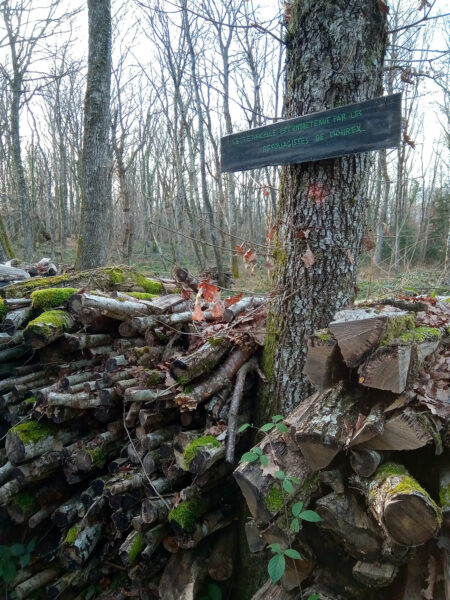
- Sections de commune are territories where traditional practices are carried out and valued by Local Communities and the Ministry of Culture alike, including traditional woodcutting and pastoralism, as well as ancient sacred sites, such as the remains of druid circles.
- They encourage extensive agriculture, which promotes biodiversity, qualifying them as state-recognized Natural Areas of Ecological, Faunal, and Floristic Interest (ZNIEFF). This biodiversity supports culturally important foods, such as cheese, which rely on grazing livestock on natural prairies.
- They allow local management of certified forests, which can serve as conserved areas and maintain old-growth forests, some of which have been continuously and sustainably managed since at least the 1600s.
- They provide numerous services to Local Communities and society at large, from clean water to local employment and sustainable tourism.
- They strengthen community resilience.
- They give resident farmers priority access to local pastures.
- They are an important form of local democracy and continue to be places where communities innovate.
- Their members manage these territories at no cost to the state, annually volunteering hundreds of hours to manage forests, waters, and pastures, often providing services where the state no longer has the capacity to do so.
How Do Other European Countries Legally Recognize and Support Similar Local Community Territories?
Throughout Europe, many countries have commons managed by Local Communities. Here are a few examples of legal recognition:
- Italy: Law No. 168 of November 20, 2017, on collective domains (Norme in materia di domini collettivi) formally recognizes and protects common territories, including the frazioni, which correspond exactly to the sections de commune, for their environmental services, identity, and value for future generations.
- Romania: The commons were reconstituted with Restitution Law 1/2000. From a legal point of view, they are considered private land, as “juridical persons.”
- Switzerland: Cantons recognize their commons (e.g., bourgeoisies, patriziati, and korporationen) as collectively owned and managed, with rights dating back to the Federal Charter of 1291.
- Slovenia: Agrarian communities (agrarne skupnosti) can legally register their common lands, and in 2026, these were classified as national cultural heritage.
- Spain: Commons are mentioned in the Constitution and continue to function today, providing hundreds of thousands of commoners with social, economic, and environmental services. Specific laws protect these collective governance and property systems from alienation, whether by the state or the private sector.
- United Kingdom: The Commons Act 2006 provides a statutory framework for registering common land and supporting its governance.
Call to Action
The ICCA Consortium calls on the government of France to:
- Consult all rights-holders about the future of their sections de commune before debating the proposed law, in line with the international norm of free, prior, and informed consent (FPIC).
- Commission independent studies on the sections de commune so that law proposals rely on scientific evidence rather than repeating the same unsupported claims that have been made for over 200 years that these territories are “old-fashioned and serve no purpose.” This logic was debunked by the Nobel Prize-winning research of Elinor Ostrom and her colleagues.
- Assess the economic costs the state would take on if more than 30,000 sections de commune became entirely government-managed instead of community-managed.
- Assess the environmental impact of transferring more than 30,000 sections de commune to the municipalities.
- Consider the implications of this law for France’s ability to comply with the Kunming-Montreal Global Biodiversity Framework (KM-GBF).
- Consider the implications and lost potential of implementing the European Union’s (EU) Nature Restoration Law in a truly participative and community-based manner.
- Consider the impact of the loss of sections de commune on future generations.
- Change the law to promote these territories as places of local democracy, social cohesion, intergenerational transmission, and important for local livelihoods, biodiversity, and a range of services.