Adivasi communities resisting escalated militarization and mining industries in central India
First published on 03/30/2026
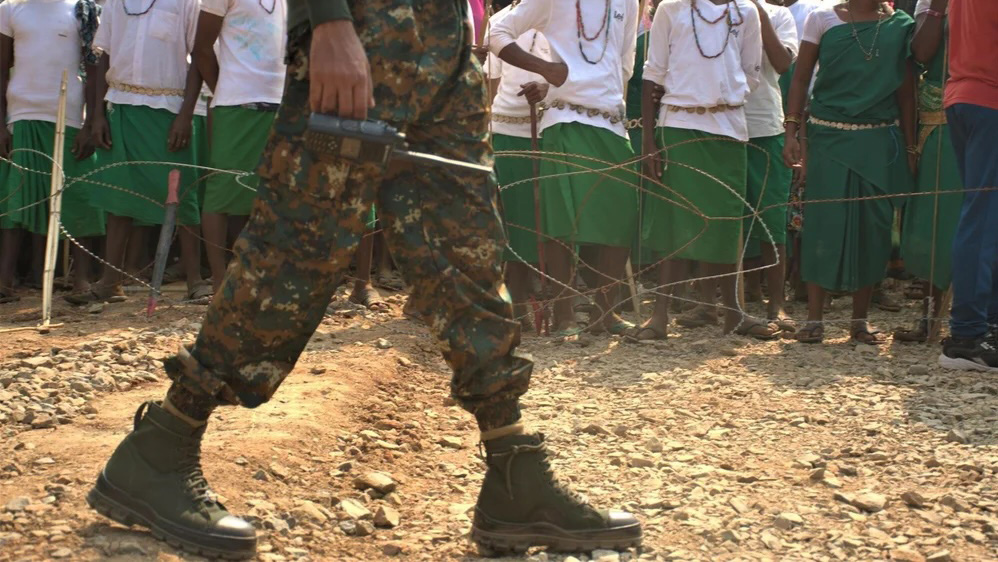
In central India’s Chhattisgarh state, in the forested, hilly region of Bastar, Indigenous Peoples known as Adivasis are facing a combination of militarization, arrests, and mining expansion that together threaten their lives, livelihoods and governance systems. Spanning roughly 33,000 square kilometers, Bastar is a biodiverse and ecologically sensitive area, home to approximately 2.7 million people, around two thirds of whom are Adivasis – India’s Indigenous peoples – including the Gond, Maria, Halba, and Muriya communities. For more than two decades, Bastar has also been one of the epicenters of an armed insurgency under the Communist Party of India (Maoist) – referred to by the Indian state as Naxalite or “Left Wing” extremism – which was centred in the Adivasi communities. The Indian government then used this as an excuse to frame the region primarily through a national security lens, with extensive counterinsurgency operations and militarization shaping governance and daily life. In December 2023, India’s Home Minister publicly declared that the insurgency would be eradicated by March 31, 2026 – setting a political deadline that has since shaped a new phase of security operations across the forest areas inhabited by Adivasis. Reports from the ground describe increased armed operations, expansion of security camps, killings characterized as “counterinsurgency encounters,” and the imprisonment of youth leaders of the growing justice-based peacebuilding movements under stringent anti-terror and public safety laws. At the same time, mining leases are being issued to private companies, exploratory permits are being converted into extraction approvals, and forested land is being cleared in preparation for mining and industrial activity. For Adivasi communities in Bastar, these developments are considered two sides of the same coin. Militarization, criminalization of community organizing, and extractive industry expansion are unfolding together, in one of India’s most mineral-rich regions and the ancestral homeland of millions of Indigenous people.
Many of the Adivasi communities in the Bastar region are forest-dependent societies, whose agricultural cycles, forest produce harvesting practices, cultural institutions, and governance systems are tied closely to local land, forest, and rivers (“jal, jangal, jameen”) managed collectively and sustainably for generations. The region is also rich in iron ore, coal, tin, and rare earth minerals. But despite this resource abundance, Bastar remains one of India’s poorest regions by most social indicators, including health, literacy, and infrastructure access. This combination of ecological significance, mineral wealth, and a politically marginalized Indigenous population, has made the region a longstanding target for extractive development and state violence against the people’s resistance in the region.
India is a constitutional democracy that formally recognizes special protections for Scheduled Tribes (the official designation for Adivasis) under the Fifth Schedule of its Constitution. Laws such as the Forest Rights Act and the Provisions of the Panchayats (Extension to Scheduled Areas) Act (commonly referred to as PESA) recognize community forest rights and require local consultation in decision-making over land and resources. In principle, these frameworks provide strong legal grounds for Indigenous self-governance and for consent-based development. In practice, however, most forested land in Bastar remains legally classified as state-owned forest, even where communities have lived, farmed, and governed these territories for generations, enabling mining leases and industrial concessions to be allocated through state processes that frequently bypass meaningful community consent. Targeting of Adivasi human rights defenders continues unabated and uninvestigated. Environmental impact assessments and public hearings required under Indian law have in multiple cases been rushed or manipulated, and exploration and extraction licenses for mining concessions have been issued under unusually short procedural timelines.
For decades, Bastar has also been a nerve centre of the Naxalite/Maoist insurgency, which has resisted the entry of mining corporations in the region. Many insurgents have come from the marginalized Adivasi rural communities, which has allowed the state to characterize the area as a security problem, with development defined as the elimination of armed groups. For many Adivasi community members, therefore, development has come primarily in the form of displacement, forest loss, militarization, and a coercive state presence. Local activists describe this as developmental violence – a process in which extraction and infrastructure are introduced through military operations. Since 2024, new military camps have expanded into forest areas, sometimes placed only a few kilometers apart, restricting mobility and creating conditions in which routine activities such as forest produce gathering or farming carry risk of detention or death. Killings by militarized police (security forces), described as “encounters” with insurgents, in many cases constitute extrajudicial executions of civilians found in the forest, and reports of arbitrary arrests, sexual violence, and intimidation are rising.
| Year | Deaths | Arrests | Surrenders | Total | Deaths % | Arrests % | Surrenders % |
|---|---|---|---|---|---|---|---|
| 2020 | 40 | 438 | 342 | 820 | 4.9 % | 53.4 % | 41.7 % |
| 2021 | 51 | 494 | 551 | 1,096 | 4.7 % | 45.1 % | 50.3 % |
| 2022 | 30 | 291 | 415 | 736 | 4.1 % | 39.5 % | 56.4 % |
| 2023 | 20 | 387 | 398 | 805 | 2.5 % | 48.1 % | 49.4 % |
| 2024 | 217 | 925 | 792 | 1,934 | 11.2 % | 47.8 % | 41.0 % |
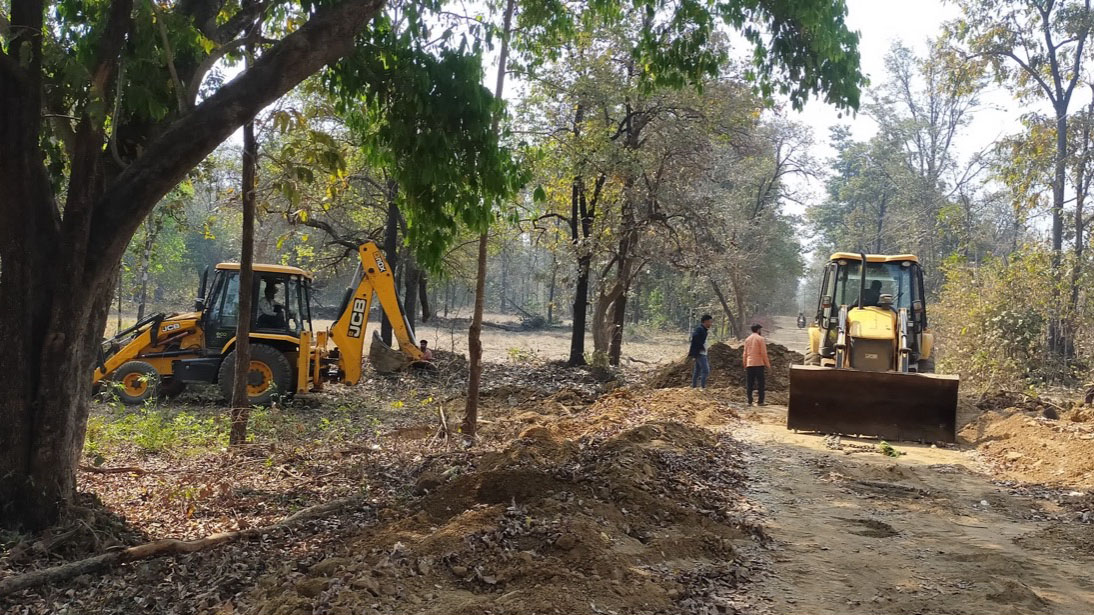
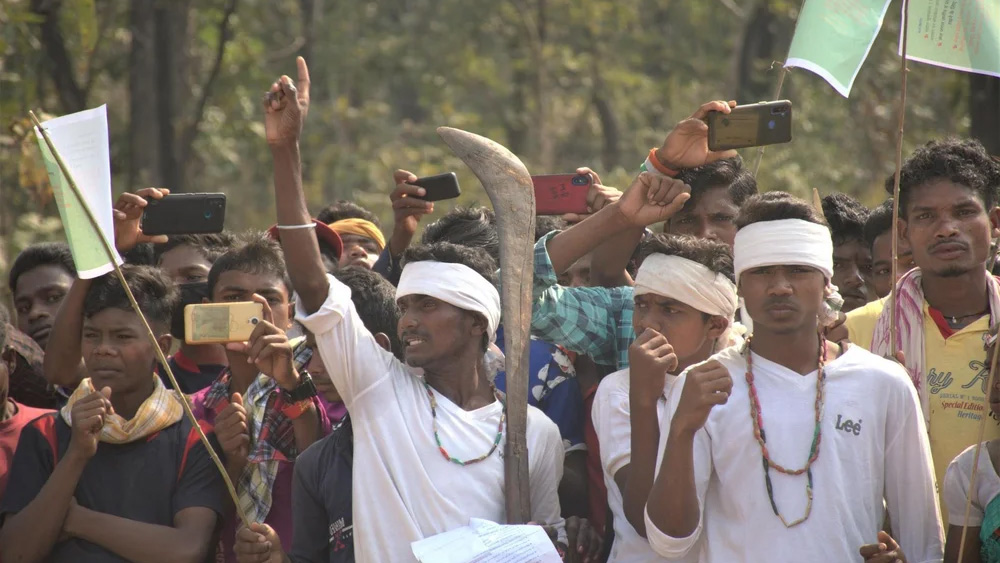
In 2021, Adivasi youth began organizing justice-based peacebuilding initiatives that sought to address violence across the Bastar region, while demanding implementation of constitutional protections and accountability for abuses by military personnel, as well as asserting Adivasi territorial rights against mining. By 2024, more than 40 protest sites had emerged across southern Bastar. In October 2024, the largest of these youth platforms was declared unlawful, and many leaders were arrested under anti-terror and anti-sedition legislation, effectively halting visible public mobilization. Dozens of Indigenous youth activists have been surveilled, humiliated, intimidated, and detained, and the suppression of peaceful organizing has significantly narrowed civic space. Meanwhile, security operations have intensified and mining operations accelerated. Tender notices for new mining blocks continue to be issued and in some areas land and forest clearing has already begun. Communities have pointed out a recurring pattern in which intensified operations against suspected insurgents are followed by the allocation of mining rights and the physical entry of extraction infrastructure.
The state narrative suggests that with the “eradication” of the insurgency, development will proceed unburdened. Some recent reports suggest that the frequency of killings has slightly decreased, yet militarization remains extensive and many youth leaders remain in detention. The March 31, 2026 deadline for insurgency eradication continues to weigh on local activists and community leaders, with fears that intensified operations may resume as that date approaches.
The ongoing crisis in Bastar – of extrajudicial killings, mass incarceration of activists, criminalization of dissent, and land grabbing – is an extreme case of a broader global pattern in which Indigenous territories are dispossessed for corporate-state extractive industry. What distinguishes Bastar is the scale of militarization and state violence, combined with the speed of mining expansion in a region where constitutional protections formally exist but are simply not being enforced. Despite submissions to UN human rights mechanisms and engagement with international Indigenous rights fora, the crisis remains relatively invisible globally, in part because India is widely perceived as a stable democracy and in part because civil society actors face significant risks in speaking out, the entry of journalists and fact finding teams is restricted, and international humanitarian organisations such as the Red Cross not allowed access at all. Bastar and its Adivasi communities require sustained international attention. Greater visibility, independent monitoring, and engagement from international civil society, Indigenous networks, researchers, human rights institutions, and international governance bodies are critical to ensuring the crisis does not remain invisible.