Reflections From the Practice of Rainforest Foundation US
First published on 09/22/2026, and last updated on 09/25/2026
Victor Gil, Zoë Dutka, Christine Halvorson, Christopher Jarrett, Joshua Lichtenstein, Maryka Paquette, Laura Piccoli, Jessica Rogers, and Gina Ruiz-Caro Rothgiesser
Rainforest Foundation US
* Correspondence: vgil@rainforestus.org
Indigenous Peoples and Local Communities (IPs and LCs) receive less than 1% of international climate finance. Most of it arrives through intermediary organizations whose role has been increasingly questioned. This article examines four partnerships in which Rainforest Foundation US (RFUS) acted as an intermediary between donors and IP and LC organizations: long-term partnerships in Guyana, fiscal sponsorship of the Global Alliance of Territorial Communities, bilateral funding channeled to the Mesoamerican Alliance of Peoples and Forests, and an Indigenous-government collaboration for land titling in Peru. Through internal reflection, we ask what helped open pathways toward direct funding and where that work hit its limits. Three patterns emerge: arrangements built around partners’ funding structures and institutional moments rather than a single model; a distinction between administrative capacity and the political-institutional capacities IP and LC organizations already hold; and the use of institutional position to redistribute, rather than concentrate, access to donors. Direct and intermediated funding form a continuum of complementary pathways, and intermediation can advance direct access when it is deliberately transitional and supports the consolidation of IP- and LC-led financing mechanisms.
Indigenous Peoples and Local Communities (IPs and LCs) generate significant environmental outcomes through the exercise of their territorial rights and traditional governance systems. Their territories hold approximately 36% of the world’s remaining intact forests and consistently show lower deforestation rates than surrounding lands (Fa et al., 2020; World Resources Institute, 2023).
Even so, IPs and LCs receive less than 1% of international climate finance (Rainforest Foundation Norway [RFN], 2021). This gap reflects barriers that keep resources concentrated among actors distant from local realities: eligibility criteria incompatible with how IP and LC organizations are constituted; institutional capacity gaps across the sector; a scarcity of predictable, flexible, and fit-for-purpose financing; and entrenched imbalances of power and trust (Charapa Consult, 2022; Rainforest Foundation UK et al., 2022; Rights and Resources Initiative [RRI] & RFN, 2022). Closing this gap requires sustained medium- and long-term investment, accompanied by reforms that confront the historical inequalities underlying the current funding ecosystem.
Over time, many organizations have positioned themselves to fill these gaps, becoming central to how funding reaches IPs and LCs. These organizations are commonly grouped under the label “intermediaries,” a term without a settled definition but typically applied to any actor that receives resources from donors and transfers them to local organizations, sometimes providing additional non-financial services. The breadth of the term, however, obscures a tension that runs through intermediary practice. At times intermediaries work to create the conditions for IP and LC organizations to access climate finance autonomously, while at others they reinforce the very dysfunctions they should be resolving in order to perpetuate their position as a conduit for resources. Identifying and addressing this tension is essential for any intermediary that aims to channel fit-for-purpose resources directly to IPs and LCs. As climate finance grows more complex and IPs and LCs take on a more central role in climate action, how intermediaries operate, the functions they retain, and the mechanisms by which they account for their actions all merit examination (Charapa Consult, 2022). The aim is to ensure they contribute to, rather than obstruct, the change that places IPs and LCs in direct control of resources intended to support their rights and territories.
This article examines four partnership arrangements in which Rainforest Foundation US (RFUS) acted as an intermediary between donors and IP and LC organizations. Looking at our own practice, we ask what helped open pathways toward direct funding and toward reducing the need for RFUS to act as an intermediary, and what the limits of that work were.
Intermediaries in Context
Before turning to that examination, it is worth situating intermediaries in the context of funding for IPs and LCs and in the broader literature on philanthropy and development, where their role has been increasingly questioned. For a long time, the need for intermediaries was justified by the benefits they offered donors, such as efficient transfer of resources to the local level, centralized due diligence, and reduced transaction costs (Yang et al., 2024; Gibson & Mottola, 2024; Indufor, 2023). More recently, however, the question has shifted to what intermediaries offer the organizations receiving resources, and whether they actually redistribute power or simply pass on the administrative burden. This distinction separates pass-through functions, which leave decision-making authority with donors, from those that bring resources, governance, and agenda-setting closer to communities (Childress et al., 2024; Rodericks et al., 2024). From the perspective of IPs and LCs, intermediation often places a layer between them and donors that can act as a useful buffer from bureaucratic functions that are not well aligned with territorial realities, but it can also serve as a barrier that keeps power and decisions distant from communities. Where this layer functions as a barrier, IP and LC organizations report resources routed through multiple intermediaries, accountability requirements that multiply at each layer, and decisions about priorities made far from themselves (Charapa Consult, 2022; Springer, 2024).
Intermediaries face incentives to maintain their position as gatekeepers of resources. Beyond the financial and reputational pressure to be seen as reliable by donors (Gibson & Mottola, 2024; Fruitema et al., 2025; Rodericks et al., 2024), intermediaries also face the more basic incentive of organizational self-preservation, since a fully functioning direct funding ecosystem could, in principle, diminish their current role and shape institutional behavior in ways that are not always made explicit. When intermediaries are unable or unwilling to adapt the way they add value, they can begin to operate as second-tier donors, exercising disproportionate influence over sub-grantees and reducing partnerships to transactional exchanges (Eade, 2007; Charapa Consult, 2022; Fruitema et al., 2025). Donors compound this picture by privileging organizations with bureaucratic systems similar to their own, bilingual teams with international training, and established brand recognition–a combination that favors international NGOs over locally rooted organizations (Gibson & Mottola, 2024; Charapa Consult, 2022; Fruitema et al., 2025; Rodericks et al., 2024; Springer, 2024).
Another common justification for using international NGOs as intermediaries is the assumption that IP and LC organizations do not hold the capacities needed to receive resources directly. Capacity, however, is not a neutral concept (Eade, 2007; Grantmakers for Effective Organizations, 2021). Donors are too often the ones who shape the term’s meaning, narrowing it to the administrative capacity needed to meet accountability and compliance standards, and ignoring the capacities IP and LC organizations already hold, such as territorial governance, political advocacy, and other institutional competencies these organizations value (Charapa Consult, 2022; Indufor, 2023; Springer, 2024). The distinction between capacity as understood by donors versus as understood by IPs and LCs matters because the issue is not an absence of capacity but a mismatch between the administrative requirements of the current climate finance ecosystem and the institutional forms through which IP and LC organizations operate (Charapa Consult, 2022; Indufor, 2023; Springer, 2024).
Compounding this is an accountability problem: intermediaries typically answer to donors for financial compliance and reporting, but rarely to the IP and LC organizations they serve (Childress et al., 2024; Hodgson & Pond, 2018). Donors, in turn, at times select the intermediaries they work with without considering these intermediaries’ capacity to engage with IPs and LCs, or without giving IPs and LCs a meaningful role in choosing those intermediaries themselves (Indufor, 2023). For IPs and LCs, downward accountability is not just good practice but a rights-based requirement, anchored in the United Nations Declaration on the Rights of Indigenous Peoples (UNDRIP) and in the principle of free, prior, and informed consent (Charapa Consult, 2022).
These problems are not inherent to intermediation itself but emerge when it is treated only as a neutral service of moving resources rather than as a choice with structural consequences and political implications (Gibson & Mottola, 2023; Rodericks et al., 2024). A more strategic approach requires donors to consider whether the intermediaries they select, or that are selected by IPs and LCs directly, contribute, over time, to building the infrastructure, networks, and relationships that allow grassroots organizations to access funding directly (Childress et al., 2024). In the IP and LC context, this would translate, for example, into more predictable and longer-term funding, greater allocation for institutional support, simplified and harmonized requirements across donors, and investment in platforms and financial mechanisms led by IPs and LCs themselves (Charapa Consult, 2022; RRI & RFN, 2022). The question, then, is not whether intermediaries should exist, but whether their roles are designed to overcome the obstacles that prevent resources from reaching IP and LC organizations and communities directly.
Some models already answer this question affirmatively. Regional regranting funds, organizations with an explicit mandate to support rights-based work, and constituency-led intermediaries accountable to communities have grown stronger as alternatives, repositioning funding as an instrument for decentralizing power rather than an operational service for donors (Gibson & Mottola, 2024; Hodgson & Pond, 2018; Rodericks et al., 2024). What distinguishes these models is not the volume of resources they move but the composition of governance, directions of accountability, and the framing of funding and additional services as a redistribution of power.
Among these, IP- and LC-led financing mechanisms stand out, built to internalize what external intermediaries rarely can: governance by their own constituencies and accountability requirements adapted to the languages and working rhythms of the organizations and communities. By 2025, 42 such mechanisms had been established in tropical forest countries, with 16 of the 21 territorial funds based in Latin America and the Caribbean, and marked acceleration since 2020 (GATC & RFUS, 2026). The Mesoamerican Territorial Fund, examined later, and the Shandia Platform, which seeks to strengthen and consolidate these new instruments across Mesoamerica, the Amazon, Indonesia, and Africa, are examples of this model in operation (Charapa Consult, 2022; GATC & RFUS, 2026). The growth of these mechanisms shifts the terms of the conversation about intermediation: as IP- and LC-led options expand, intermediaries are challenged to continually demonstrate and evolve their value proposition to ensure their contribution remains relevant to the funding ecosystem for IPs and LCs (Indufor, 2023; RRI & RFN, 2022).
Methodological Framework
This article is part of a small body of self-reflective writing produced by intermediary organizations about their own practices, particularly by organizations with an explicit mandate to support the rights of IPs and LCs (see also Forest Peoples Programme, 2025; RRI, 2026).
RFUS is a non-Indigenous organization founded in 1988 in the United States with a mission to raise and channel resources to support the rights of IPs and LCs in Latin America. Over time, our institutional strategy evolved to support IP and LC partners in opening pathways for direct funding to their organizations, leading us to continually re-assess and adjust how we are adding value to the partnerships. As a primarily English-speaking, US-based INGO with established administrative infrastructure, RFUS plays an intermediary role in the dynamics described above, and the analysis examines that position.
To examine how we have done this work, we conducted an internal reflection on three guiding questions: How did RFUS facilitate funding for IPs and LCs through different intermediation arrangements? How did we contribute to opening pathways for direct funding? How can we continue adapting our institutional roles in service of partners? Our analysis starts from the ecosystem gaps the literature identifies as barriers to direct funding for IPs and LCs (Charapa Consult, 2022; Indufor, 2023; RRI & RFN, 2022; Springer, 2024), examining how RFUS worked to address them across different partnerships. Based on this initial assessment, we selected four cases to capture variation in geography, duration, volume of resources, donor type, and intermediation partnership model. The cases were first developed for internal reflection and shared with peers and partners in late 2025,[1] and the present article builds on that earlier work.
The limits of this approach must be acknowledged from the outset. All cases come from RFUS’s own experience, and the authors are members of the organization’s staff. We have direct access to the information documented here, but not to independent data on how IP and LC counterparts experienced the partnerships, and the analysis is inevitably shaped by our interest in how RFUS’s role is perceived. The findings are practice-based insights, offered for debate among donors, intermediaries, and IP and LC organizations, who are invited to test them against their own experience and contest them where they do not hold up.
Table 1
Comparative Overview of the Four Case Studies Analyzed
| Case Study | Geographic Scope | Period | Funding Facilitated | IP and LC Organization(s) | Donor Type(s) |
| 1. Long-term partnerships in Guyana | Guyana | 2015–2025 (10 years) | US$7 million (64% intermediated, 36% direct) | Amerindian Peoples Association (APA) and South Rupununi District Council (SRDC) | Bilateral agencies, private foundations |
| 2. Fiscal sponsorship for movement building | Global | 2019–2025 (6 years) | US$9.8 million (100% intermediated) | Global Alliance of Territorial Communities (GATC) | Private foundations |
| 3. Bilateral funding in Mesoamerica | Mexico and Central America | 2021–2024 (3 years) | US$3.4 million (41% intermediated, 59% direct) | Mesoamerican Alliance of Peoples and Forests (AMPB) | Bilateral government agencies, private foundations |
| 4. Indigenous-government partnerships for land titling in Peru | Peru | 2023–2024 (2 years) | US$530,000 (100% intermediated) | Asociación Interétnica para el Desarrollo de la Selva Peruana (AIDESEP) | Private foundations, individual donors |
Case Study 1: Long-Term Partnerships in Guyana
This case examines a decade-long partnership between RFUS and two Indigenous organizations in Guyana: the Amerindian Peoples Association (APA) and the South Rupununi District Council (SRDC).
In 2015, both APA and SRDC operated under significant resource constraints. The funding landscape posed multiple challenges: short cycles of one to two years, rigid budget categories, and limited support for institutional strengthening. Access to larger funding was restricted by donor requirements for specific administrative infrastructure, creating a circular barrier: organizations needed experience managing large grants to obtain the funding that would let them build that experience.
The partnership addressed these challenges along several lines. RFUS worked with APA and SRDC to develop and secure multi-year agreements with Norway’s International Climate and Forest Initiative (NICFI), resulting in approximately US$2.8 million channeled to APA and US$850,000 to SRDC between 2016 and 2025. RFUS supported the organizations in accessing an additional US$670,000 for APA from eight different donors and US$130,000 for SRDC from five sources. Acting as intermediary for these resources, RFUS conducted joint annual planning and review processes in which APA and SRDC defined programmatic priorities, with transparent financial accountability in both directions. This sustained funding over nearly a decade gave them essential organizational stability.
During this period, APA and SRDC established direct relationships with donors, both on their own initiative and with RFUS’s support in proposal development and strategic donor introductions. This support helped them secure more than US$2.5 million in additional funding. Both organizations were able to negotiate dedicated lines for organizational development within their grants, while RFUS and other partners provided complementary technical support.
APA grew from five staff members and an annual budget of US$153,000 to 15 full-time employees across specialized departments, with an annual budget of US$1.7 million—an elevenfold increase since 2015. SRDC evolved from two full-time staff and US$120,000 annually to 12 full-time employees and an annual budget of US$1.1 million in 2025. This funding allowed them to hire qualified staff and invest in developing new policies, building robust internal systems, and continuing to strengthen the governance structures that already existed.
Today, both partners manage large, multi-year direct grants. In 2025, RFUS represents less than 5% and 7% of the organizational budgets of APA and SRDC, respectively. APA and SRDC now sub-grant to RFUS for specific technical services, a concrete reversal of the traditional intermediation relationship that points to the relational character built over time.
In Guyana, financial intermediation filled gaps and opened pathways to direct funding relationships. Direct and intermediated models functioned as complementary mechanisms, not competing approaches. The shift required ongoing work, and RFUS evolved its position in the local ecosystem to keep contributing in other ways, including through non-financial services.
Case Study 2: Fiscal Sponsorship for Movement Building
This case examines a six-year fiscal sponsorship partnership between RFUS and the Global Alliance of Territorial Communities (GATC), a global movement that represents 35 million people across 958 million hectares in 24 countries.
GATC’s leaders coordinate advocacy across 24 countries, five languages, and multiple time zones, while also leading organizations in their own countries or regions. This work demands coordination mechanisms and infrastructure that take time to build. Establishing the formal organizational infrastructure needed to access and manage large-scale funding typically requires years of development, which can divert effort from the core work of advocacy and movement building.
GATC chose RFUS as its fiscal sponsor based on alignment of values, and RFUS developed a set of fiscal sponsorship services, including access to 501(c)(3) tax status, administrative infrastructure, and ongoing technical assistance for operations, fundraising, grant management, financial administration, and logistical coordination. Periodic reviews of the relationship allowed for recalibrations. This arrangement has let GATC focus on advocacy and communications while gradually developing its organizational structures, including building a Technical Secretariat. RFUS provided intensive operational support in the early stages and worked to transfer operational functions to GATC as its Technical Secretariat developed. RFUS also supported GATC on climate finance advocacy and on developing priority initiatives such as the Shandia Platform, a global initiative designed to channel direct funding to IPs and LCs through regional and national mechanisms, peer learning, and strengthened dialogue with donors and partners.
As of 2025, GATC had a 15-person Technical Secretariat, with specialized teams for political advocacy, communications, program management, logistics, and administration. Its funding base has diversified from dependence on a single major donor to partnerships with more than a dozen foundations, raising annual revenue from approximately US$500,000 to nearly US$4 million. GATC also holds formal advisory seats on bodies such as the Forest and Climate Leaders’ Partnership (FCLP) and the Tropical Forests Forever Facility (TFFF), where they are actively shaping the future of IPs’ and LCs’ role in climate finance.
From this experience, we suggest that fiscal sponsorship, when offered with progressive transfer of functions, allows IP and LC organizations to respond in real time to political opportunities or crises. It lets them focus on programmatic work while preserving their political and territorial character. In GATC’s case, the intermediary provided administrative infrastructure together with progressive transfer of functions. The case also suggests that the creation of IP- and LC-led fiscal sponsors could provide shared infrastructure that allows IP and LC organizations to outsource administrative functions indefinitely and decentralize funding at scale.
Case Study 3: Bilateral Funding in Mesoamerica
This case examines a three-year partnership between RFUS, the Mesoamerican Alliance of Peoples and Forests (AMPB), and the United States Agency for International Development (USAID). The collaboration enabled AMPB to expand its work, invest in organizational capacity, strengthen the participation of women and youth, and establish the Mesoamerican Territorial Fund (FTM), an Indigenous-led financing mechanism that distributed approximately US$2 million to more than 200 communities across six countries during the project period.
Despite USAID’s commitment to locally led development (“localization”), which represented a departure from traditional funding approaches, substantial cultural and technical gaps persisted between the agency and IP and LC organizations. These included highly technical codesign processes, extensive eligibility and compliance requirements, and milestone-based disbursement models that posed challenges given the different organizational cultures, decision-making timelines, and conceptions of accountability at play.
RFUS supported the project codesign process between AMPB and USAID (USAID, 2023), preparing staff and leadership for effective participation. To meet USAID’s requirements, RFUS strengthened its own internal capacity, which allowed AMPB to access government funding while RFUS managed the associated compliance obligations. The arrangement let AMPB focus on programmatic work and organizational strengthening. RFUS also used its cash reserves to cover gaps generated by milestone-based disbursements, ensuring continuity of project implementation.
Beyond meeting USAID’s specific requirements, RFUS provided organizational development support aligned with AMPB’s own institutional priorities, including establishing the FTM as an Indigenous-led fund with its own governance structure, dedicated to reaching the territorial level. RFUS also supported the development of AMPB’s new strategic plan, assisted the Coordinator of Territorial Women Leaders (CMLT) with its regional gender and climate action plan, and enabled the expansion of the Mesoamerican Leadership School (EML).
Disaster risk training delivered by EML as part of the project strengthened communities’ climate resilience, while targeted financial support channeled through the CMLT bolstered women’s organizations at the national level. The FTM established proposal evaluation criteria, governance committees, and monitoring procedures, and raised and distributed nearly US$2 million across two funding cycles, benefiting more than 200 communities in six Mesoamerican countries. AMPB increased its organizational budget by 20% and made progress on institutional strengthening, including legal registration, a comprehensive strategic plan, and an expanded role for women and youth in governance. During the project period, AMPB raised an additional US$2 million in direct funding.
In Mesoamerica, RFUS narrowed the longstanding distance between a bilateral government donor and IP and LC organizations while also serving as a channel for funding to reach these organizations more effectively. Intermediaries with access to both sides can use that position to translate between them: bringing IP- and LC-led financing mechanisms into discussions about how to get bilateral funding to the territorial level, and bringing the scale of bilateral funding into discussions about territorial financing. Support for the creation of the FTM is one outcome of this approach that shifts authority closer to the territorial level.
Case Study 4: Indigenous-Government Partnerships for Land Titling in Peru
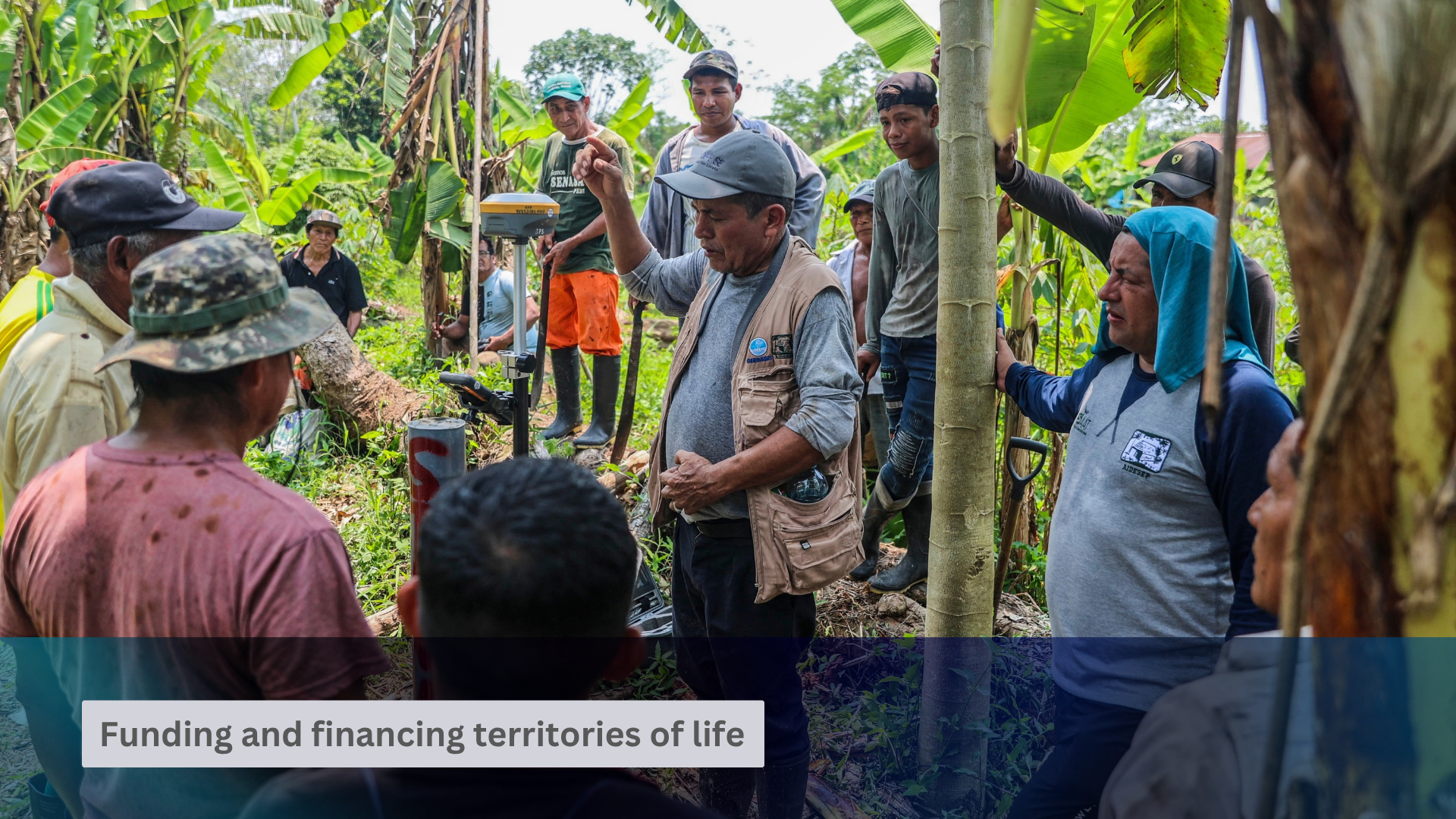
This case examines a partnership between the Interethnic Association for the Development of the Peruvian Rainforest (AIDESEP) and the Regional Directorate of Agricultural Development and Irrigation of Loreto (DIRDAGRI, previously GERDAGRI), which accelerated Indigenous land titling processes in Peru’s Loreto department. The partnership positioned AIDESEP as primary coordinator and strengthened DIRDAGRI’s operational capacity, resulting in 26 community land titles covering 77,265 hectares.
DIRDAGRI, the regional authority responsible for legally processing Indigenous land titling in Loreto, faced severe resource constraints that hindered fieldwork and the advancement of titling processes. Titling in Loreto requires transporting technical teams and materials across vast, remote riverine areas for field surveys and physical demarcation. Without sufficient funding for transport, equipment, and personnel, the agency faced a growing backlog of requests from communities.
Previous titling initiatives had channeled resources through NGOs and government contractors. These approaches proved costly on a per-community basis and often lacked the cultural competence needed for meaningful engagement with Indigenous communities, leading to delayed or incomplete titling. They also excluded Indigenous organizations from decision-making.
AIDESEP and DIRDAGRI developed a public-private partnership that restructured traditional roles. AIDESEP took on a strong coordination role, facilitating the relationship with local communities and Indigenous organizations, while DIRDAGRI maintained its technical and legal mandate to carry out physical-legal demarcation and formal titling procedures.
RFUS channeled US$190,000 from private donors to strengthen AIDESEP’s technical coordination capacity and invested another US$340,000 in local logistical infrastructure. In collaboration with the Regional Organization of Indigenous Peoples of the Eastern Amazon (ORPIO) and local federations, RFUS supported the constitution of Indigenous-led local logistics networks, offering support for business formalization, financial management training, and operational systems. These networks converted local Indigenous territorial knowledge into specialized services, enabling efficient transport of technical staff, equipment, demarcation materials, and food to remote communities.
The arrangement enabled the processing of 26 community land titles covering 77,265 hectares between 2023 and 2024. Processes that previously could take decades were completed in an average of 8 to 18 months. The approach included physical demarcation to prevent future territorial conflicts and steps to ensure titles were registered in the public land registry. AIDESEP strengthened its institutional position, evolving from a funding recipient to a strategic partner in titling. The Indigenous-led logistics networks now sustain operations beyond titling, including territorial monitoring.
In this case, RFUS’s role was modest in financial terms but structurally decisive in supporting the leadership of an Indigenous organization to overcome a common pattern among intermediaries, in which resources flow through organizations that have administrative capacity but lack the relationships, territorial knowledge, and cultural legitimacy that Indigenous organizations bring to processes such as titling. Our analysis is that what counted here was the use of RFUS’s intermediary position to shift leverage toward Indigenous organizations and communities, rather than consolidate it. The logistics networks that emerged function as infrastructure for the territorialization of climate funds.
Reflections From the Four Cases
The four cases examined here cannot be separated from the conditions of power inherent to intermediation. But taken together, they reveal patterns that help distinguish, in practice, between arrangements that open pathways to direct funding and arrangements that simply move resources. This section draws out those patterns and also names the tensions they leave open.
A first pattern we identified concerns the diversity of arrangements used to enable intermediation. In all the cases, the arrangements were built around the funding structures and institutional moments of partners, rather than by extending a single model across contexts. In practice, this depends on the intermediary’s capacity to read contexts and respond to them, an intercultural capacity built through sustained presence and listening, within long-term partnerships grounded in trust. When the intermediary starts from a donor-driven model rather than the partners’, IP and LC organizations end up pressured to mold themselves to external logics rather than access resources on terms that work for them.
A second pattern involves the distinction between administrative capacity and political-institutional capacity. Access to direct funding still requires investment in specific types of capacity that align with donor expectations. However, this should be done from the recognition that IP and LC organizations already hold capacities, without ignoring those they would most like to prioritize for investment, at the risk that IP and LC organizations find themselves pressured to deviate from their own purposes and aspirations. Institutional strengthening must be approached critically and openly among IPs and LCs, intermediaries, and donors, since it is precisely the particular political and institutional capacities that IPs and LCs hold that position them as key actors for climate action.
A third pattern concerns the use of institutional position. Reputation, networks, and access to donors can work to redistribute power toward IPs and LCs or to keep it concentrated, and the same intermediary can do both within the same partnership. It matters that the factors keeping intermediaries in the gatekeeping position be made visible, and that intentional investment go into building the conditions for IPs and LCs to access direct funding, by connecting them to donors, supporting the establishment of direct relationships, and advocating for changes in funder practice. Where this logic works, intermediation becomes deliberately transitional: the intermediary cedes functions and donor relationships and supports the consolidation of IP- and LC-led mechanisms that, over time, may render its own presence unnecessary.
These patterns, however, run up against limits that intermediaries alone cannot dissolve. The NICFI and USAID cases show that direct funding relationships with bilateral donors still face eligibility barriers, pre-qualification requirements, and disbursement models poorly compatible with how IP and LC organizations operate, which leads these donors to channel most of their resources through NGOs that operate as intermediaries (Springer, 2024). The persistence of this pattern shows that opening pathways to direct funding does not depend solely on what intermediaries do in specific partnerships, but on changes to the bilateral donors themselves that have not yet materialized at the speed the demands require.
Conclusion
The four cases show how intermediation, when designed around the rights and self-determination of IPs and LCs, can advance the direct funding ecosystem. They also show that the same arrangements carry tensions that good intentions do not dissolve: robust administrative systems that allow larger volumes of resources to move more fluidly can also reinforce donor patterns; the absorption of compliance responsibilities that enables access also consolidates the intermediary’s position; the institutional capital that opens doors can also keep them closed. Most intermediation involving IPs and LCs lives within these tensions, and it falls to intermediaries to continually examine the aspects of their own practice that perpetuate concentration of power while investing in the functions that expand IP and LC control over resources. This work, however, operates within limits that intermediaries alone cannot dissolve. Making funding systems compatible with the institutional forms of IPs and LCs requires broader changes on the donor side as well.
It is worth noting that the distinction between direct and intermediated funding is less a binary than a continuum, and the coexistence of multiple complementary pathways allows funding arrangements to be made fit-for-purpose across different contexts, institutional moments, and needs. The funding ecosystem for IPs and LCs gains resilience precisely from this range of arrangements; what matters is how resources reach IP and LC organizations, and how much authority, decision-making, and accountability sit with IPs and LCs themselves. Intermediaries have a role to play in building funding ecosystems that work for IPs and LCs, provided they are open to redesigning themselves as IPs and LCs take on greater leadership, ceding functions and relationships where they no longer add value and investing where the contribution remains specific and significant. IP and LC organizations and funds themselves have been articulating expectations for how intermediaries should work, and intermediaries committed to this transition should use these as a benchmark.
A central part of intermediaries’ contribution at the current moment is supporting the growing architecture of Indigenous-led funds and other territorial financing mechanisms. Investing in these Indigenous intermediaries shifts resources toward arrangements that internalize, by their very constitution, what external intermediaries can only approximate. For an intermediary with a specific mandate to support the rights of IPs and LCs, like RFUS, taking its own principles seriously implies welcoming this development, supporting it materially, and being prepared for the possibility that it reduces and changes the need for its current role. Our task is to keep shifting what we do so that, when the field no longer needs us in our current functions, we can adapt and find new ways to add value, while continuing to build pathways to greater leadership and direct access to funding by Indigenous Peoples themselves.
Acknowledgments
The authors acknowledge the collaboration and contributions of the Amerindian Peoples Association (APA), the South Rupununi District Council (SRDC), the Global Alliance of Territorial Communities (GATC), the Mesoamerican Alliance of Peoples and Forests (AMPB), and the Interethnic Association for the Development of the Peruvian Rainforest (AIDESEP), all long-standing partners of RFUS. All received copies of the case studies and raised no objection to their content or publication. We note that this consent is procedural in nature and does not necessarily amount to a substantive review conducted by the partners. The views expressed in this article are those of the authors and do not necessarily reflect those of the organizations mentioned.
References
Charapa Consult. (2022). Directing funds to rights: Principles, standards and modalities for supporting Indigenous Peoples’ tenure rights and forest guardianship.
https://charapa.dk/wp-content/uploads/Directing-Funds-to-Rights-Full-report.pdf
Childress, S., Driver, S., Gallardo, A. A., Goldfarb, J., Mallillin, A., Mease, L., Sanchez Gill, A., & Vo, A. (2024, April 18). How movement-accountable intermediaries can change philanthropy. Stanford Social Innovation Review.
https://doi.org/10.48558/9WQC-MH79
Eade, D. (2007). Capacity building: Who builds whose capacity? Development in Practice, 17(4–5), 630–639.
https://doi.org/10.1080/09614520701469807
Fa, J. E., Watson, J. E. M., Leiper, I., Potapov, P., Evans, T. D., Burgess, N. D., Molnár, Z., Fernández-Llamazares, Á., Duncan, T., Wang, S., Austin, B. J., Jonas, H., Robinson, C. J., Malmer, P., Zander, K. K., Jackson, M. V., Ellis, E., Brondizio, E. S., & Garnett, S. T. (2020). Importance of Indigenous Peoples’ lands for the conservation of intact forest landscapes. Frontiers in Ecology and the Environment, 18(3), 135–140.
https://doi.org/10.1002/fee.2148
Forest Peoples Programme. (2025). Valuing Allyship: The case for pairing direct and unrestricted funding with solidarity-based allyship for grassroots Indigenous Peoples and forest peoples.[Briefing papers].
https://www.forestpeoples.org/publications-resources/briefing-papers/article/valuing-allyship/
Gibson, C., & Mottola, M. (2024). Working with intermediaries strategically. Robert Wood Johnson Foundation.
https://www.rwjf.org/en/insights/our-research/2024/02/working-with-intermediaries-strategically.html
Global Alliance of Territorial Communities & Rainforest Foundation US. (2026). Indigenous Peoples and Local Communities-led financing mechanisms: Mapping of existing funds in tropical forest countries. Unpublished.
Grantmakers for Effective Organizations. (2021). Reimagining capacity building: Navigating culture, systems, and power.
https://www.geofunders.org/resource/reimagining-capacity-building-navigating-culture-systems-power/
Hodgson, J., & Pond, A. (2018). How community philanthropy shifts power: What donors can do. Global Fund for Community Foundations.
https://globalfundcommunityfoundations.org/resources/how-community-philanthropy-shifts-power-what-donors-can-do-t/
Indufor. (2023). Forging resilient pathways: Scaling up funding in support of Indigenous Peoples’ and local communities’ tenure and forest guardianship in the Global South.
https://landportal.org/library/resources/forging-resilient-pathways
Fruitema, M., Pertiwi, R., Thornley, A., Hakim, L., & Chandra Pinanditha, A. (2025). From transactional to relational: Guidelines for equitable intermediaries in Indonesia. Menjadi; Saraswati.
https://learn.planetindonesia.org/wp-content/uploads/2025/04/Transactional-to-Relational-Report.-Planet-Indonesia-and-Menjadi.-Spreads.pdf
Rainforest Foundation Norway. (2021). Falling short: Donor funding for Indigenous Peoples and local communities to secure tenure rights and manage forests in tropical countries (2011–2020).
https://cwis.org/wp-content/uploads/2021/06/rainforestmanagement.pdf
Rainforest Foundation UK, Rainforest Foundation US, & Rainforest Foundation Norway. (2022). Realising the pledge: How increased funding for forest communities can transform global climate and biodiversity efforts.
https://rainforestfoundation.org/wp-content/uploads/realise-the-pledge.pdf
Rainforest Foundation US. (2025). Contributing to a more resilient direct funding ecosystem for Indigenous Peoples and Local Communities: Case studies on intermediary support.
https://rainforestfoundation.org/wp-content/uploads/How-Climate-Finance-Can-Reach-Indigenous-Peoples-and-Local-Communities-IS-case-studies.pdf
Rights and Resources Initiative. (2026). Lessons learned from CLARIFI’s grantmaking experience.
https://rightsandresources.org/publication/lessons-learned-from-clarifis-grantmaking-experience/
Rights and Resources Initiative & Rainforest Foundation Norway. (2022). Funding with purpose: A study to inform donor support for Indigenous and local community rights, climate, and conservation.
https://rightsandresources.org/publication/funding-with-purpose/
Rodericks, A., Cock, C., Gioacchino, G., Gouthami, Lomé, M., Tapia, M., García, L., Villa, L., & Pasupathy, S. (2024). Understanding the re-granting ecosystem in the Global South: Environment, gender, social justice & human rights in Asia, Latin America and the Caribbean. Ruta Cívica; Oak Foundation.
https://philanthropydialogues.org/wp-content/uploads/2024/09/RutaCivica_Part3_Voices-from-practice_Understanding-regranting-ecosystems-in-the-Global-South.pdf
Springer, J. (2024). Localizing bilateral finance for community rights: Recommendations for United States Agency for International Development. Path to Scale, Rights and Resources Initiative.
https://rightsandresources.org/publication/localizing-bilateral-finance
United States Agency for International Development. (2023). Learning document: Co-creation with Indigenous partners.
https://drive.google.com/file/d/1MWvqAqb7qExsExrLnIL-XmOwnstakeSI/view?usp=sharing
World Resources Institute. (2023). Indigenous Forests Are Some of the Amazon’s Last Carbon Sinks.
https://www.wri.org/insights/amazon-carbon-sink-indigenous-forests
Yang, E., Grundhoefer, S., Smith Arrillaga, E. (2024). Bridging the gap: Grantee perspectives on intermediary funders. Center for Effective Philanthropy (CEP). (2024). Bridging the gap: Grantee perspectives on intermediary funders. https://cep.org/report-backpacks/bridging-the-gap-grantee-perspectives-on-intermediary-funders/?section=overview#intro
Reviewed by: Femy Pinto and Hanieh Moghani
Copyediting: Jessica Merriman
Editorial lead: Mohammad Arju
Published by the ICCA Consortium
© 2026 The Authors
Published under the terms of the Creative Commons Attribution-NonCommercial 4.0 International license.
Citation: Gil, V., Dutka, Z., Halvorson, C., Jarrett, C., Lichtenstein, J., Paquette, M., Piccoli, L., Rogers, J., & Ruiz-Caro Rothgiesser, G. (2026). The role of intermediaries in enabling direct funding for Indigenous peoples and local communities: Reflections from the practice of Rainforest Foundation US (Funding and financing territories of life). ICCA Consortium. https://doi.org/10.70841/BH76HY5
[1] First published as: “Contributing to a More Resilient Direct Funding Ecosystem for Indigenous Peoples and Local Communities: Case Studies on Intermediary Support,” by the present authors (RFUS, 2025).