First published on 09/25/2026
Indigenous peoples in Peru play a fundamental role in the conservation of the Amazon, the world’s largest tropical rainforest and a crucial ecosystem for the planet’s balance. However, they face significant challenges that hinder their ability to utilize forest resources, and they lack effective tools for forest management. Similarly, 16.3% of the population that self-identifies as Indigenous lacks electricity in their homes, 26.4% lacks access to potable water, and 40.4% lacks sanitation services (Ombudsman’s Office, 2023).
Added to this are the long distances they must travel to contact the relevant authorities when their territory is threatened. In response to this situation, Indigenous communities have strengthened their own monitoring and early warning mechanisms to maintain a constant presence throughout their territory, prevent activities that affect their collective rights, and promptly channel information to the appropriate authorities.
Since 2018, the Asociación Interétnica de Desarrollo de la Selva Peruana (Interethnic Association for the Development of the Peruvian Rainforest, AIDESEP) has been promoting its Early Warning and Action System (SAAT), a mechanism that allows it to collect information on the different threats in its territory, report them and promote coordination with the competent authorities for their attention and follow-up.
“The Monitoring and Control Committees play a fundamental role in identifying and reporting threats in their territories, sending their reports to their regional organizations, which coordinate with AIDESEP’s SAAT, carrying out an advocacy process with institutions for effective and timely attention from the State,”
said AIDESEP forestry specialist Sheila Sotero.
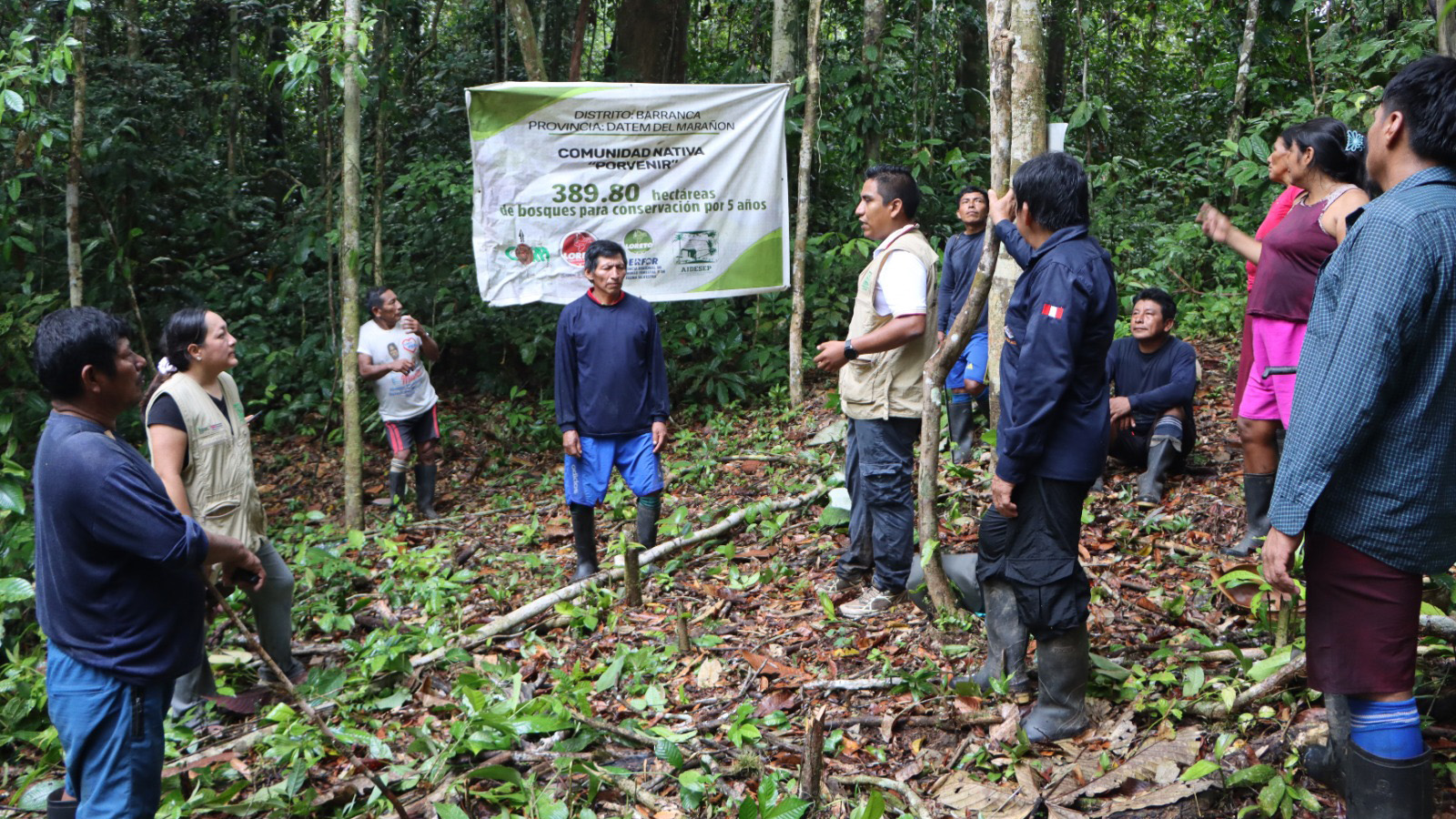
While this initiative is a significant achievement for Indigenous communities, it requires strengthening access to and use of the tools through training and equipment to ensure effective operation. In this context, AIDESEP and WWF Peru, within the framework of the BLF Andes Amazon project, have facilitated the recognition of 193 members of the CVC (Community Conservation Committee) in 25 native communities in Loreto and Amazonas as forest custodians by the Regional Forestry Development and Wildlife Management Offices (GERFOR) and the Regional Environmental Authority of Amazonas (ARA Amazonas), thus integrating Indigenous conservation initiatives with state authorities.
Community oversight and control committees beyond monitoring
One of the most pressing issues facing Indigenous communities is the forestry fines levied by the Supervisory Agency for Forest Resources and Wildlife (OSINFOR) for non-compliance with forestry and wildlife regulations. This sometimes occurs due to a lack of awareness of the law or because communities have ceded the use of forest resources to third parties.
By 2026, according to OSINFOR records, the Amazonian regions with the highest number of sanctioned communities include Loreto, Ucayali, Junín, and Amazonas, among others, with fines totaling over 87 million soles. These payments are inaccessible to the communities, making it crucial to address solutions that enable sustainable forest management and take into account the realities of the territory and its stakeholders.
Therefore, AIDESEP and its regional organizations have built the Indigenous Forestry Agenda, which includes five priority measures aimed at the effective attention of the State for the inclusion of native communities in the value chain of wood and non-timber forest products.
“With the Indigenous Forestry Agenda, we advocate for full respect for the rights of Indigenous peoples and promote sustainability and legality in the use of our forests. Within this framework, we work to ensure that communities have access to compensation mechanisms for forestry fines ,” stated the forestry specialist from AIDESEP.
For its part, OSINFOR has established mechanisms to offset fines, allowing native communities to convert financial penalties into active conservation efforts. In this way, the CVCs, with their forest custodians, have become key players in supporting a solution to this situation.
With the formation and recognition of these committees, it is possible to access and carry out the different activities contemplated in the fine compensation mechanisms, such as monitoring of areas designated for conservation, control and surveillance activities, supervision activities, and training activities.
“In this process, the formation and equipping of community monitoring and control committees have been fundamental. The communities receive guidance and capacity building to access this OSINFOR mechanism, enabling them to reduce their fines and commit to conserving impacted areas. Furthermore, it guarantees the survival of forest species and fauna that depend on these forests, thus increasing opportunities to improve their livelihoods,”
says Walter Aguirre, a specialist with WWF Peru.
Through the BFL Andes Amazon project, AIDESEP and WWF are supporting the Regional Coordinator of Indigenous Peoples (CORPI-SL), the Regional Organization of Indigenous Peoples of the Northern Peruvian Amazon (ORPIAN-P), and the Awajún Autonomous Territorial Government (GTAA) to reach the communities that have been fined, provide them with technical support to request compensation for these fines, and then ensure they fulfill the activities outlined in their compensation plans, such as patrols, among others, as well as submitting the annual compliance reports requested by OSINFOR. The goal is to support 34 native communities in their compensation processes for fines valued at over 2.7 million soles, which represent 235,352 hectares of conserved land over the next 5 years.
BLF Amazon Andes
The BLF Andes-Amazon Project aims to contribute to the transformation of existing systems in the Andes-Amazonian Landscape, a transboundary territory between Peru and Ecuador, renowned for its high biodiversity and cultural richness. To this end, the project promotes strategic interventions focused on biodiversity conservation, strengthening governance, integrating a gender perspective, climate finance, and developing sustainable value chains. These actions seek to promote sustainable livelihoods, reduce deforestation and biodiversity loss, and contribute to climate change adaptation and mitigation.
The BLF Andes Amazon is funded by UK International Development under the Biodiversity Landscapes Fund and implemented by a consortium led by Practical Action and including NCI, AIDESEP, WWF, TERRA NUOVA and COSPE.
Learn more: www.blfandesamazonico.org