Recap and reflections
First published on 12/19/2025, and last updated on 04/27/2026
By Neema Pathak-Broome, International Policy Coordinator, ICCA Consortium
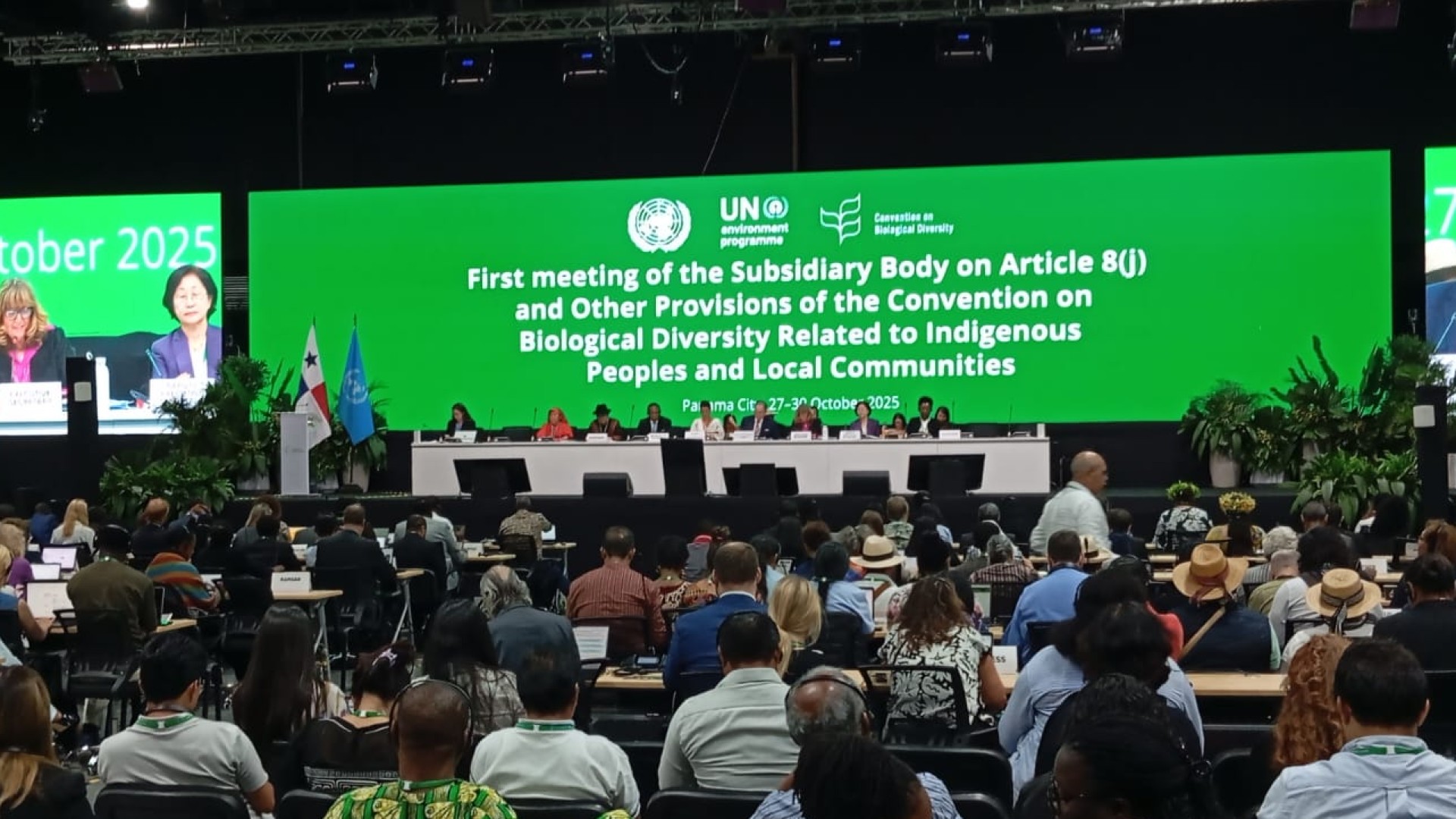
The Convention on Biological Diversity’s (CBD) first meeting of the Subsidiary Body on Article 8(j) and Other Provisions of the Convention Related to Indigenous Peoples and Local Communities (SB8j-1) was recently held in Panama.
CBD’s article 8(j) has long recognized the need to respect, preserve, and maintain the knowledge, innovations, and practices of Indigenous Peoples and Local Communities and to promote their wider application with the approval and involvement of the knowledge holders themselves. Yet, until now, this mandate has been implemented through an ad hoc working group or by integrating these concerns into other processes. The establishment of a subsidiary body dedicated to these concerns represents institutional recognition that the rights, knowledge, and governance systems of Indigenous Peoples and Local Communities were central to biodiversity conservation and sustainable use.
A milestone for participation
The meeting in Panama brought together party delegates, representatives of Indigenous Peoples and Local Communities, supporting organizations, and other observers. The meeting’s agenda reflected the reality that to halt and reverse biodiversity loss, many of the Kunming-Montreal Global Biodiversity Framework (KMGBF) targets depend directly on Indigenous Peoples and Local Communities’ stewardship of lands, waters, and territories.
Seven items were up for discussion, including the development of a new program of work under article 8(j), mechanisms for participation, and modalities for monitoring IPLC-related contributions under the KMGBF. Delegates also discussed procedural matters, including the election of a co-chair and the nomination of regional representatives to the bureau and its “Friends of the Bureau.” The latter refers to an informal but essential group of government and IPLCs representatives who support the bureau in facilitating consensus, maintaining regional balance, and ensuring inclusive dialogue between sessions. This mechanism, though understated, is often key to maintaining trust and continuity in CBD processes.
The ICCA Consortium’s engagement and contributions
Members of the ICCA Consortium participated throughout the meeting, reflecting the association’s deep roots in Indigenous Peoples and Local Community-led conservation, as well as its long engagement with CBD processes. Such engagement included co-organizing and participating in side events, as well as contributing suggestions on agenda items as part of the Indigenous Peoples and Local Communities (IPLCs) Caucus.
In Panama, in the lead-up to the official SB8j-1, the Consortium members attended a preparatory gathering of the IPLC Caucus. This gathering brought together Indigenous and Local delegates and their allies to strategize, coordinate interventions, and review agenda items. The ICCA Consortium members contributed their experiences and perspectives on community governance, particularly regarding the recognition of Indigenous and Traditional Territories (ITTs), including ICCAs-territories of life, and ensuring that new global frameworks do not undermine self-determined systems at the local level.
The IIFB, acting as the IPLCs Caucus, was expected to designate seven members, one from each of the seven sociocultural regions, to serve as Friends of the Bureau. Additionally, they were expected to select one member to serve as co-chair during the meeting, along with the president of the sixteenth meeting of the Conference of the Parties or a representative. This was done during the caucus’s preparatory meeting, when all participants chose to convene in regional groups and select members from among them to serve on the Friends of the Bureau. Gunn Britt Retter (Arctic region) was unanimously proposed as the co-chair for the SB8j-1.
Subsequently, as the official sessions began, Consortium members, through the caucus discussions and side events, ensured that the new program of work under article 8(j) remains grounded in community realities. They reminded the delegates that conservation must recognize these relationships as living systems of governance, not as isolated technical measures.
Inside the Indigenous Peoples and Local Communities Caucus
One of the most active spaces during the week was the IPLCs Caucus, where delegates and supporting organizations from Indigenous Peoples and Local Communities gathered to review drafts, exchange updates, and develop common positions. Much of the caucus’s time was spent discussing and debating appropriate ways to respect the distinct rights of “Indigenous Peoples” within international legal and policy frameworks, while not weakening the rights of other traditional local communities and Indigenous Peoples in many countries where legal and policy systems do not distinguish between the “Indigenous Peoples” and “Local Communities.” Because of prolonged and intense debate on this, less attention could be given to other items, such as the guidelines on ITTs, mechanisms for participation, and the integration of Indigenous People and Local Community indicators into the KMGBF monitoring framework.
Despite this, the caucus demonstrated strong collaboration and effort. The caucus reviewed the text to be debated in the plenary and contact groups. The caucus also provided comments on the draft guidelines and other texts shared by the CBD secretariat.
The review emphasized that any framework for ITTs must be built on the foundations of Free, Prior, and Informed Consent and respect for customary governance systems. The caucus also reaffirmed the importance of Indigenous and traditional knowledge systems as distinct yet complementary to scientific knowledge in biodiversity decision-making.
SB8j-1 main meeting
A recurring theme throughout the meeting was the need to ensure that the KMGBF is implemented in ways that genuinely empower communities rather than further centralize control and affect the territorial and other specific rights of Indigenous Peoples and Local Communities. Many interventions underscored that the success of global targets — including those on area-based conservation, ecosystem restoration, and resource mobilization — depends on whether Indigenous Peoples and Local Communities have secured rights over their lands and territories and are meaningfully supported in their conservation contributions. With this foundation in place, conservation can avoid risks of becoming another form of exclusion or dispossession.
Guidelines on ITTs in the context of targets 2 and 3
One of the critical points of discussion during the SB8j-1 was agenda item 5 on guidelines for ITTs, particularly in the context of targets 2 and 3.
The ICCA Consortium policy team, participating in discussions on the ITT guidelines, submitted various textual suggestions on the draft shared by the CBD secretariat. Particularly of interest to the policy team was ensuring recognition of ITTs (and ICCAs) as a distinct “pathway” for achieving target 3, as well as recognition of ITTs (and ICCAs) and the rights of Indigenous Peoples and Local Communities in situations where existing Protected Areas (PAs) and Other Effective Area-based Conservation Measures (OECMs) overlap with ITTs (and ICCAs).
Recognizing and supporting these territories in general, as well as in the context of targets 2 and 3, requires more than symbolic acknowledgment; it demands legal, political, and financial mechanisms that enable communities to exercise their ways of being, traditional knowledge, and collective rights and responsibilities. In this context, the significance of the concept of ICCAs-territories of life, also became amply clear.
Participants also highlighted the need for reconciliation where overlaps exist between PAs and Indigenous or traditional territories. Many communities continue to face restrictions, displacement, or marginalization due to conservation policies that fail to respect their governance systems. The discussions in Panama reiterated that the path forward must be one of co-governance and partnership, grounded in respect and equity in existing overlap situations.
However, the final text, which has been accepted by the Parties and will be sent to COP17 for discussion, raises many serious concerns that will need to be addressed and strategized upon in the intervening period.
Anticipating such areas of concern in the draft guidelines, Indigenous People and Local Community participants, including Consortium members, had argued that these guidelines should remain a “living document,” evolving and developing over time based on on-the-ground experience. However, despite multiple efforts by the caucus, this recommendation could not be incorporated into the proposed draft guidelines.
The text related to “distinct pathway” (Para. 28) has been placed entirely in parentheses, indicating that there was no agreement on this, and it will be up to the parties to retain or discard it during the next COP. The party delegates present during SB8j-1 expressed confusion about the terminology of ITTs in relation to targets 2 and 3 and were not convinced that all ITTs contribute to target 3. Fears were expressed that retaining this language would undermine target 3’s objectives.
Party delegates also raised concerns about the lack of clarity regarding the processes for reporting and monitoring ITTs under target 3. Towards this, the policy team organized a quick consultation with partner organizations to discuss the possibility of using existing platforms such as ICCA Registry, LANDMARK, Indigenous Navigator, among others, for monitoring and reporting on ITTs/ICCAs as a distinct pathway to achieve targets 2 and 3.
Based on this, the caucus in the contact group suggested an additional paragraph for inclusion in the guidelines. The party delegates agreed to add a separate para; however, due to time constraints, the text was not included in the final proposed draft guidelines.
The challenge of finance and the call for enabling environments
Underlying many discussions in Panama was the issue of financing. While biodiversity funding is increasing globally, much of it remains locked within large international institutions, rarely reaching the communities directly or indirectly. Participants called for the creation of direct, flexible, and timely financing mechanisms that respond to the self-determined priorities of Indigenous Peoples and Local Communities.
Way forward
SB8j-1 exposed the challenges of moving from recognition to realization. Institutional spaces like this can easily become absorbed by procedural complexities and political sensitivities, while the urgent, grounded realities of communities risk being sidelined.
For ICCA Consortium members, the lessons are clear. Engaging in these processes is essential, not only to influence decisions but to ensure that the lived experiences of communities continue to shape global policy. However, engagement must always remain grounded in the daily struggles and achievements of those who sustain territories of life. The work ahead involves both defending these spaces internationally and strengthening them locally. Also, much more preparatory work and internal consultations are needed before members participate in future discussions on these guidelines in SB8j meetings and COP17.
In the end, the success of the subsidiary body and of the KMGBF will not be measured by the number of decisions adopted or guidelines produced. It will be measured by whether Indigenous Peoples and Local Communities have increased protection in their territories, more territorial integrity, strengthened governance systems, and greater respect for their knowledge and values.
Creating the conditions for this to happen requires trust, equity, and resources. It requires moving beyond rhetorical recognition to practical action — building financing mechanisms, legal reforms, and participatory processes that truly empower IPLCs. As many participants in Panama agreed in spirit, the real test of progress is whether communities can continue to live well and care for their territories of life on their own terms, in their own ways.