A new case study explores how the U’un Tidung are revitalizing customary governance and community-led conservation in their ancestral village in Sabah
First published on 05/12/2026, and last updated on 06/02/2026
By ICCA Consortium
The report, titled “Kampung Dagat: A Tidung fishing community in Borneo revitalizing adat and protecting rivers, wetlands, and forests,” was recently published by LEAP Spiral and the ICCA Consortium. It examines how Kampung Dagat has navigated intersecting pressures over recent decades and how its experience illuminates both the possibilities and the limits of community-led conservation and self-determined development in Sabah.
The case study report is the result of long-running self-strengthening efforts within the community; co-authors include nine community leaders.
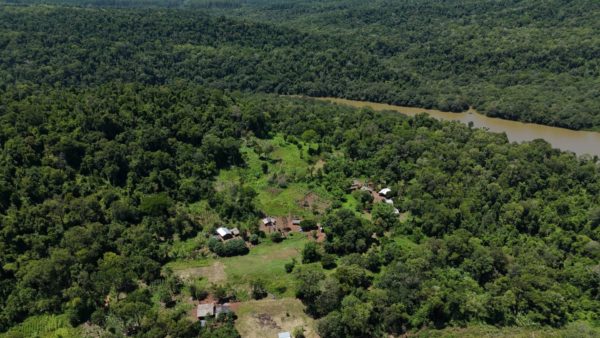
On the northeastern coast of Borneo, where the Kinabatangan and Segama river deltas meet the Sulu Sea, lie the kampungs (villages) of the U’un Tidung, the Tidung People. For generations, the Tidung here in the northeast of Malaysia’s Sabah state have thrived, maintaining a culture that cares for this biological corridor that connects the world-famous Danum Valley forest upstream with coastal mangroves in the estuary.
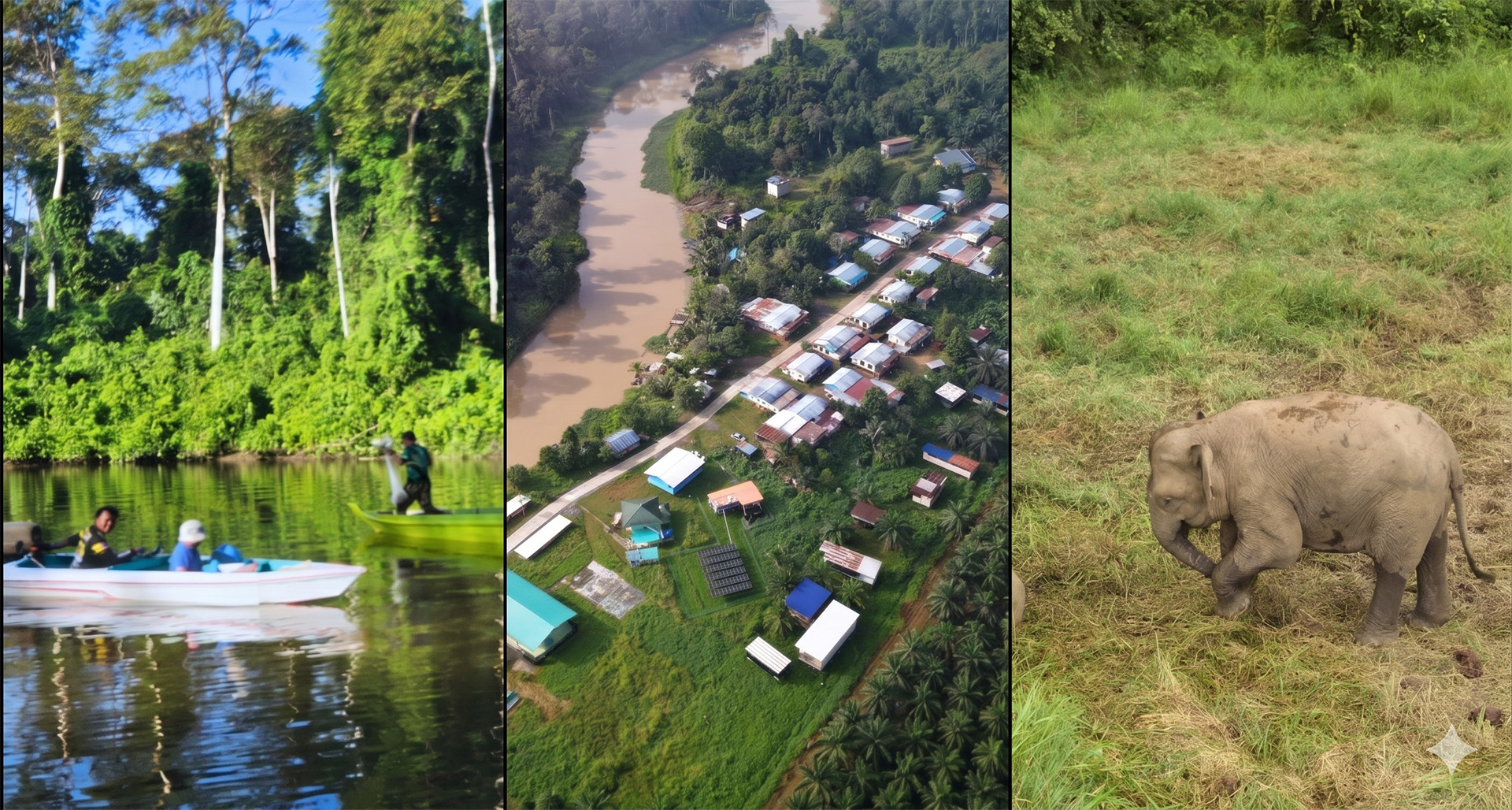
Kampung Dagat is a Tidung community whose homeland is marked by an interplay of fresh, brackish, and marine waters. Life here thrives on land and underwater: Borneo pygmy elephants, orangutans, and hornbills live alongside Irrawaddy dolphins, olive ridley sea turtles, and black snapper. One of the Tidung’s most important origin stories is Buluh Betung, which tells of a child born from bamboo, and reminds each generation that human life and the forest share one breath.
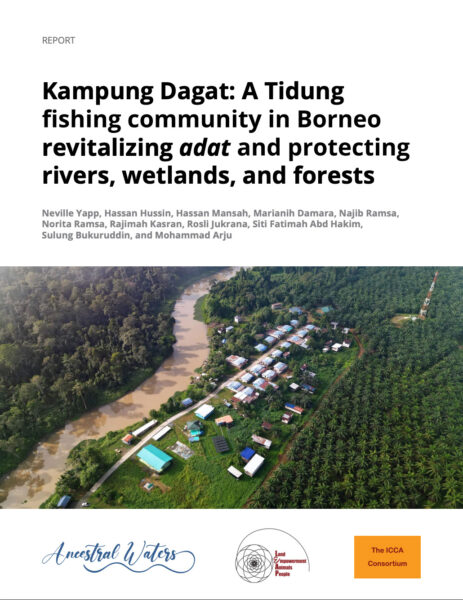
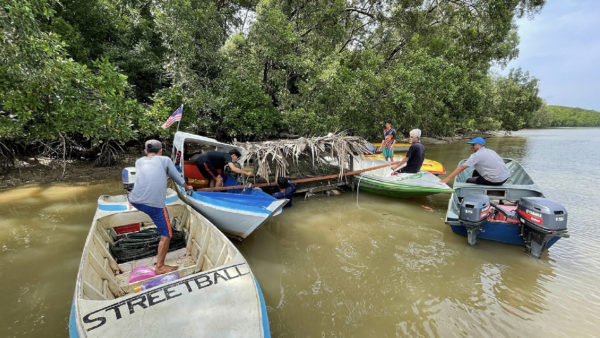
Community members here have made their living fishing for generations. Stories passed down serve as living principles that guide how community members fish, farm, and govern their territory, incorporating inherited ecological knowledge about the tides, lunar phases, seasons, rivers, and forests.
But Kampung Dagat’s traditional territory, home to 43 households with almost 250 people, is also the site of increasing threats from resource extraction and conservation alike. Dagat’s native customary land, which oral history tells us once stretched from the Kutai River in Kalimantan to the Sabahan coast, is now confined to around 260 hectares—overlapped by oil palm plantations and two of Malaysia’s largest protected areas: the Tabin Wildlife Reserve and the Lower Kinabatangan Segama Wetland. Mounting pressure on the land and sea from logging, plantations, and commercial trawling has decimated agricultural productivity and critical fish stocks and harmed the community’s access to clean water.
Contemporary economic challenges add to these threats: lack of roads restricts access to markets, health clinics, and schools, and inadequate state infrastructure leaves households dependent on diesel generators and costly transport. Climate change further amplifies existing challenges. Increased flooding, shifting rainfall, and changes in river salinity disrupt fish spawning cycles, directly affecting food security and incomes. These shifts also complicate the timing of traditional practices such as rattan harvesting, making it harder to sustain rituals and ecological rhythms linked to the Tidung’s adat (customary laws and traditions).
Many of the ecological and economic issues facing Kampung Dagat stem from the logging boom of the 1960s, when the state of Sabah prioritized large-scale timber extraction, followed by mass oil palm plantation development. Sabah’s Wildlife Conservation Enactment in 1997, created partly in response to such environmental devastation, further limited access to traditional territories by strengthening wildlife protection at the expense of community livelihoods. And although the community applied for the legal recognition of its 222-hectare communal forest reserve nearly eight years ago, the state’s Lands and Surveys Department has yet to process the application. Faced with these mounting threats, the people of Kampung Dagat have spent the last decade organizing collectively to defend their territory and revitalize their adat law as a living system of governance.
Since 2015, the village has implemented a series of practical measures to build community capacity, improve communal knowledge, and engage people outside the village to build solidarity and support. They formed a community association, Persatuan Komuniti Kampung Dagat, a gender-inclusive platform rooted in adat that coordinates fisheries and tourism, corresponds with government agencies, and has developed key renewable energy and forest protection initiatives.
The Dagat community association has developed a system to log catch records for all fishers, with a trained youth team logging daily catch weights and gear types and coordinating with neighboring communities to develop mutually agreed fisheries management protocols, identify key target species, and study annual trends. In 2022, the association launched its first renewable energy project: a 5.4kW solar panel to power an ice machine, producing ice blocks for fishers to improve seafood processing for sustainable income.
In collaboration with LEAP Spiral, a youth-elder team mapped the community’s territory, using handheld GPS units to record settlement history, sacred sites, fishing grounds, and forest resources. The resulting georeferenced map has since been used to support land management and advocacy efforts, including submission to state land and forestry departments, as well as to the 2018 revision of the Tabin Wildlife Reserve management plan, resulting in stronger communal access rights to the conservation area. In their own communal forest reserve, a volunteer ranger unit studies resident orangutan populations and local plants, establishes nature trails, and responsibly collects non-timber forest products for sustenance and sale.
Alongside continued advocacy and territorial defense, the community is exploring practical pathways to strengthen everyday resilience, including improving water security, access to healthcare, and diversified income projects like a village tree nursery and ecotourism program. Efforts to engage state energy-planning, fisheries, forestry, and land agencies are ongoing, and a village cohort of filmmakers regularly produces short films to raise awareness and rally support for their community’s needs.
Through community-led institutions, participatory mapping, citizen science, and the renewal of customary practices, Kampung Dagat has worked to protect its rivers and forests while asserting its rights to remain on ancestral land and to participate meaningfully in decisions that affect it.
Despite limited legal pathways for the formal recognition of their territory, the community’s long-term vision sees Tidung native customary land rights secured – so that its future generations inherit not only the land, sea, and their resources, but also the values of adat and the spirit of resilience that has enabled the community to adapt and endure. This community’s experience demonstrates that community-led land and sea stewardship is already delivering concrete outcomes; the remaining question is whether state institutions will move at a pace and scale that matches the community’s long-standing efforts.